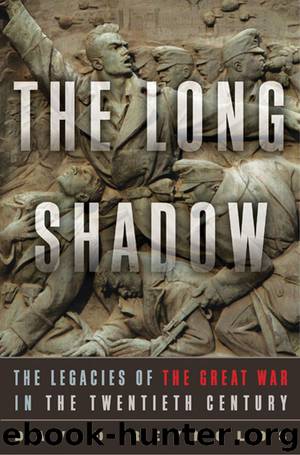
The Long Shadow: The Legacies of the Great War in the Twentieth Century by David Reynolds
Author:David Reynolds [Reynolds, David]
Language: eng
Format: epub, mobi
Publisher: W. W. Norton & Company
Published: 2014-05-12T00:00:00+00:00
So the crisis of 1940–41 proved a turning point for both Britain and America in how they viewed the Great War. Its effects were consolidated by what happened between 1941 and 1945. The outcome, this time, was total victory—brought about for Britain by a novel and, as it proved, lasting dependence upon America that unlike the post-1918 era, now assumed a permanent leadership role in global affairs.
The fall of France was again crucial because it removed the Western Front that had been central to the Great War. Although the British narrative of the war highlights Britain fighting on “alone” in 1940–41, the eventual defeat of the Third Reich occurred largely on the Eastern Front, which had been the Allies’ weakest link in 1914–18. After Hitler turned east to mount Operation Barbarossa, for the rest of the war at least two-thirds of the Wehrmacht was engaged against the Red Army. Between June 1941 and D-Day in June 1944, 90 percent of German Army battle casualties (killed, wounded, missing, and prisoners) were inflicted by the Soviets.40 If Stalin beat Hitler (and that was a big “if” until late 1942), then the Soviet Union would inevitably end the war deep in eastern Europe, making it a major factor in the postwar world.
As soon as Barbarossa began, Stalin kept demanding that the British mount a “Second Front” in France. He was not deceived by Churchill’s encouraging noises, quickly recognizing the deep British reluctance to cross the Channel, and even taunted the prime minister to his face that the British Army was scared to fight the Germans. Churchill was furious, but the accusation was essentially true. Stalin, a brutal dictator ruling over a country with huge reserves of population, had no compunction about using hundreds of thousands of troops as cannon fodder; Churchill, leading a small democracy still haunted by the Somme, shunned going head to head with the Wehrmacht. He told Stalin repeatedly, “I would never authorise any cross-Channel attack which I believed would lead to only useless massacre.” Even in mid-1942, with Russia and America as allies, he still felt that “upon the whole, our best chance of winning the war is with the big Bombers. It will certainly be several years before British and American land forces will be capable of beating the Germans on even terms in the open field.” Although Churchill wrote detailed memoranda about invading the Continent, his preference was for a series of landings around the coast of occupied Europe by “armies of liberation” spearheaded by British and American “armoured and mechanised forces” that were “strong enough to enable the conquered populations to revolt.” He envisaged the invasion as “a knockout blow” when the Reich was on its last legs. All this was a far cry from the hazardous, concentrated assault mounted on Normandy in June 1944.41
Churchill’s peripheral strategy also reflected deep doubts about his army. After the heady days of 1940, the next two years saw a succession of British defeats—Greece, Crete, Singapore, and Tobruk. The term “BEF” was no longer taboo, but people joked that it meant “Back Every Friday.
Download
The Long Shadow: The Legacies of the Great War in the Twentieth Century by David Reynolds.mobi
This site does not store any files on its server. We only index and link to content provided by other sites. Please contact the content providers to delete copyright contents if any and email us, we'll remove relevant links or contents immediately.
| Africa | Americas |
| Arctic & Antarctica | Asia |
| Australia & Oceania | Europe |
| Middle East | Russia |
| United States | World |
| Ancient Civilizations | Military |
| Historical Study & Educational Resources |
The Radium Girls by Kate Moore(12180)
100 Deadly Skills by Clint Emerson(5023)
Rise and Kill First by Ronen Bergman(4890)
The Templars by Dan Jones(4794)
The Doomsday Machine by Daniel Ellsberg(4619)
The Rape of Nanking by Iris Chang(4324)
Killing England by Bill O'Reilly(4107)
Stalin by Stephen Kotkin(4061)
Hitler in Los Angeles by Steven J. Ross(4015)
12 Strong by Doug Stanton(3631)
Hitler's Monsters by Eric Kurlander(3456)
The Code Book by Simon Singh(3320)
Blood and Sand by Alex Von Tunzelmann(3299)
Darkest Hour by Anthony McCarten(3222)
The Art of War Visualized by Jessica Hagy(3098)
Hitler's Flying Saucers: A Guide to German Flying Discs of the Second World War by Stevens Henry(2815)
Babylon's Ark by Lawrence Anthony(2780)
Tobruk by Peter Fitzsimons(2619)
The Second World Wars by Victor Davis Hanson(2577)
